

How to Calculate Standard Error: Formula and Examples
Learn what standard error is, how to calculate it with the SE formula, and why it matters in statistical analysis. Includes a step-by-step example and tips to reduce standard error.
How to Calculate Standard Error
The standard error (SE) measures how much a sample mean is expected to vary from the true population mean. It's a key concept in statistics for confidence intervals, hypothesis testing, and assessing sampling accuracy.
What is Standard Error?
Standard error quantifies the variability of sample means around the population mean. A smaller SE means the sample is more representative; a larger SE indicates greater variability.
Standard Error Formula
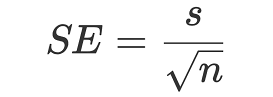
SE = s / √n
Where:
- s = sample standard deviation
- n = sample size
Example Calculation
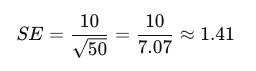
You have 50 students' test scores with a sample standard deviation of 10:
SE = 10 / √50 = 10 / 7.07 ≈ 1.41
The sample mean is expected to vary by ~1.41 points from the true population mean.
Why Standard Error Matters
1. Confidence Intervals
SE determines the range within which the true population mean likely falls. Smaller SE = narrower, more precise interval.
2. Hypothesis Testing
SE is used to calculate t-scores and z-scores in statistical tests, determining whether to reject the null hypothesis.
3. Assessing Sampling Methods
A large SE may indicate a non-random sample or insufficient sample size.
How to Reduce Standard Error
- Increase sample size — the most effective method (SE decreases as √n increases)
- Reduce sample variability — use more controlled data collection
Standard Error vs. Standard Deviation
| Metric | Measures |
|---|---|
| Standard Deviation | Variability within a single sample |
| Standard Error | Variability of sample means across repeated samples |
Conclusion
Understanding and calculating SE is essential for accurate statistical inference. It allows you to make informed decisions about population parameters from sample data.
References
- Gelman, A., Hill, J., & Vehtari, A. (2022). Regression and Other Stories. Cambridge University Press.
- Smith, M. S. (2023). Statistical Analysis: A Comprehensive Introduction. Wiley.